

It was the early 1950s when experienced rapid change in its geography and surroundings. The people of realized that times were changing, but their City was not changing fast enough. They realized that San Jose’s future was rapidly peeling away as people abandoned the downtown and moved to the suburbs of San Jose, leaving behind decaying buildings, empty stores and a reason for not going downtown. So a handful of community leaders who loved the City and who didn’t want San Jose to continue to be a case study for urban decay, got together and developed a vision for the City that was worth fighting for and Redevelopment was born--a new , , , and today, a progressive downtown, and flourishing industrial areas to the north and south of San Jose and many other projects. 
As the dreams of redevelopment transforming opportunities into realities became obvious, people with concerns for the problems in other parts of the City started saying, “why not in my community?” and redevelopment allowed others to dream as well, so projects served as an example of how the community can take control of their destiny. Redevelopment has breathed new life into neighborhoods, revitalized businesses and streetscapes, built affordable housing and continued its investment in San Jose’s economic vitality.
And so, it is the vision of San Jose’s community leaders that is the real story of redevelopment. Redevelopment is the tool that makes the dreams of the community come true. As long as people care about their community and they are committed to making it a better place, redevelopment will have a role to play--turning vision and ideas into reality.
Click here to view a timeline of the San Jose Redevelopment Agency's highlighted projects.
Invigorating an Abandoned Downtown
Downtown's decline hits its peak in the 1960s when San Jose experienced tremendous population growth in its suburban areas. Businesses and government offices moved out of the downtown area to serve the growing suburban communities, leaving downtown with vacant storefronts and buildings and increasing crime.
The Circle of Palms and the Convention Center were homes to cars and the South First Area (SoFA) was an adult entertainment, red light district featuring the 3 Star Bar and The Pussycat Theater. On West Santa Clara Street, the only high- rise in sight was the . was just a street – no archway, and no restaurant row with the exception of the . There was no light rail, no Gold Building and no and street trees were noticeably absent throughout downtown.
So, in the early 1980s, the Agency adopted the Downtown Revitalization Strategy which set priorities and identified catalyst projects that would help breathe new life into the downtown Core. The plan was followed by an aggressive implementation program, which resulted in the , , , and , over seven million square feet of new office space, 2,500 hotel rooms and 5,000 new residences.
Today, the Strategy 2000 plan serves as a blueprint for development in the Greater Downtown. The plan includes hundreds of specific recommendations to guide the future direction of downtown San Jose for additional housing, shopping, office, entertainment, 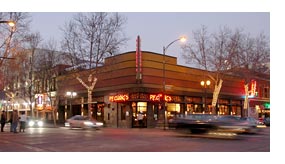 and parking. It outlines goals to make the downtown area an exciting place to live, work, shop and play; to create a walkable, pedestrian-friendly area; and to develop downtown to serve the entire city and Silicon Valley. and parking. It outlines goals to make the downtown area an exciting place to live, work, shop and play; to create a walkable, pedestrian-friendly area; and to develop downtown to serve the entire city and Silicon Valley.
Along with building new facilities, creating affordable housing and high-rise housing, and helping small businesses thrive, the Agency has invested more than $130 million towards historic preservation. Using a broad range of resource protection techniques including preservation, restoration, rehabilitation and adaptive reuse, the Agency has helped to save many of San Jose's historic buildings that would otherwise be demolished. Preservation projects have included the relocation and rehabilitation of the , , , and many more.
The Agency has built, created and invested more than $1.7 billion worth of projects and programs, including the creation of new housing units in the downtown area.
View the Redevelopment Agency's photo history slideshow to see the before and after changes in Downtown San Jose since 1975 at http://www.sjredevelopment.org/PublicationsPlans/SanJose1975.pdf
Also, view the Agency's monthly updates of the Downtown area at http://www.sjredevelopment.org/monthlyReports.htm.
Paving the Path for Technological Innovation
 San Jose is the frontier of industrial development and the Agency's redevelopment areas are home to some of the world's most innovative companies. From large employers like , , , and , to small start-up companies, San Jose's innovators are developing the technologies of tomorrow. San Jose is the frontier of industrial development and the Agency's redevelopment areas are home to some of the world's most innovative companies. From large employers like , , , and , to small start-up companies, San Jose's innovators are developing the technologies of tomorrow.
Since 1977, the Redevelopment Agency has invested more than $430 million in infrastructure that supports San Jose's innovative business community. San Jose's five industrial redevelopment areas--Rincon de los Esteros, Edenvale, Monterey Corridor, Julian-Stockton, and Olinder--are the engine of the city's economy, home to over 2,200 companies with more than 77,000 employees. The Agency's investments in these areas, as well as its support of San Jose's business incubator program, have spurred economic development and helped make San Jose the world's center of innovation.
Rincon de los Esteros, San Jose's first industrial redevelopment area in North San Jose was established in 1974. Bounded by Highways 101, 880, and 237, this 4,800-acre technology park is home to over 1,200 world-renowned companies that employ over 55,000 people. The Agency has provided funding to build roads, highway connectors, and flood control systems. Companies with a major presence in the area include , , , and , just to name a few.
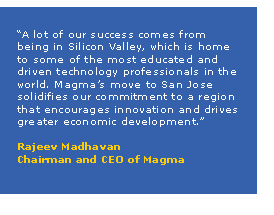 In 2005, the City Council approved , a new area development policy, allowing for high-density, mixed-use development that reflects the needs of today's companies and employees. The Agency has committed to funding $30 million of transportation improvements to support the transformation of into an even more sophisticated workplace for San Jose 's innovators.
new R&D facility is the first new construction that is part of the . In 2005, the City Council approved , a new area development policy, allowing for high-density, mixed-use development that reflects the needs of today's companies and employees. The Agency has committed to funding $30 million of transportation improvements to support the transformation of into an even more sophisticated workplace for San Jose 's innovators.
new R&D facility is the first new construction that is part of the .
Edenvale Technology Park, located in South San Jose, is a hub for innovative companies and emerging technologies such as bioscience, nanotechnology, and new energy technologies. Edenvale is home to over 300 companies, including , , , , and many more. Since 1977, the Redevelopment Agency has invested over $90 million in infrastructure improvements that make Edenvale a premier destination for the corporate community, including improvements to Highway 85, the extension of Hellyer Avenue, and the Fontanoso Way and Silicon Valley Boulevard Bridges.
Several years ago, the Agency partnered with to expand the , a world-class, state-of-the-art bioscience business incubator and laboratory facility located in Edenvale. Today, the is home to 23 companies in the life sciences and bioconvergence industries, anchoring a growing life sciences cluster in Edenvale.
In 2006, the created the Edenvale Emerging Technologies Fund, to provide support to biotechnology and emerging technology companies locating in Edenvale. , a solar energy technology company, recently received assistance from this fund to locate its R&D and manufacturing headquarters in Edenvale.
The other three Redevelopment industrial areas include Monterey Corridor, Julian-Stockton, and Olinder. They are home to hundreds of business support companies and manufacturing. The Redevelopment Agency has invested more than $257 million in these three areas, which have more than 700 companies that employ over 10,000 people.
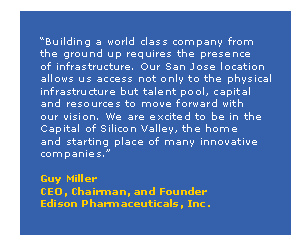 While building infrastructure is necessary, having programs to support start-ups and young companies is also crucial. Eighty-five percent of new jobs in San Jose are created by companies less than ten years old. In order to support entrepreneurship and job creation in cutting-edge industries, the Redevelopment Agency has invested more than $19 million in a business incubator program. These incubators--The , , , and --have created over 4,000 jobs and launched more than 240 companies. While building infrastructure is necessary, having programs to support start-ups and young companies is also crucial. Eighty-five percent of new jobs in San Jose are created by companies less than ten years old. In order to support entrepreneurship and job creation in cutting-edge industries, the Redevelopment Agency has invested more than $19 million in a business incubator program. These incubators--The , , , and --have created over 4,000 jobs and launched more than 240 companies.
The Redevelopment Agency is currently planning an Electronic Transportation Development Center, a place where Silicon Valley companies will collaborate on the design and development of advanced transportation technologies that address energy, homeland security, and vehicle safety needs. With an eye to the future, the Agency continues to support programs that advance San Jose 's status as the world's center of innovation.
View the Redevelopment Agency's monthly updates of the Industrial areas at http://www.sjredevelopment.org/monthlyReports.htm.
Reinventing San Jose's Neighborhood-Serving Commercial areas
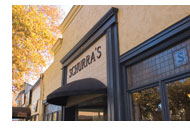 Squeezed by the upscale chain malls and big box stores, to compete, San Jose's older commercial areas are redefining themselves. Squeezed by the upscale chain malls and big box stores, to compete, San Jose's older commercial areas are redefining themselves.
San Jose's Neighborhood Business Districts (NBD) are once again vibrant and offer unique shopping experiences, providing the adjacent neighborhoods with much-needed services and goods and attracting regional shoppers seeking merchandise and products not found in large malls and mainstream retail stores. With innovative programs and projects, older commercial areas have been transformed into attractive retail and service oriented districts.
Since the NBD program began in the mid-1980s, nine older neighborhood-serving business districts and four business clusters have been improved with streetscape improvements which included new street trees, pedestrian scale lighting, landscaped median islands, parking lots and specialty features accenting the shopping district. More than 500 commercial buildings have been enhanced through the Redevelopment Agency's successful Facade Improvement Program (FIP), which provides architectural
services and grant funding to refresh tired buildings and attract new businesses and customers to the business districts. 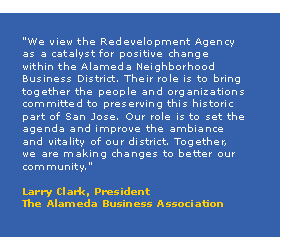
The investment in these older commercial areas has expanded beyond the transformation of the neighborhood business districts. These projects have acted as a catalyst as evidenced by private investment in the development of new housing and homeowner initiated rehabilitation and beautification in the adjacent residential neighborhoods.
The Agency has invested more than $270 million to revitalize San Jose's older commercial areas.
The Redevelopment Agency's Neighborhood Business Districts (NBD) and commercial areas include--, Alum Rock Avenue, , , Winchester Boulevard, , and Luna Park/North 13th Street.
View the Redevelopment Agency's monthly updates of the Neighborhood Business Development areas at http://www.sjredevelopment.org/monthlyReports.htm.
Property Values in Strong Neighborhood
Redevelopment Project Area Soar
Most San Joseans would agree that San Jose is a big city with the feel of a small town--This feeling is reinforced by effort, a successful grassroots revitalization effort that is driven 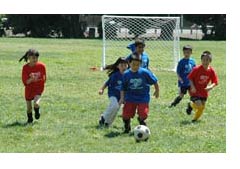 by residents, businesses, property owners and schools to improve their neighborhoods. by residents, businesses, property owners and schools to improve their neighborhoods.
In a recent review of tax revenues by the and the San Jose Redevelopment Agency, the data suggests that the exhibited strong positive growth in revenues since the plan adoption started in Fiscal Year . The Agency does not collect tax increment from these areas. Therefore, the will receive increased property tax revenue of approximately $7 million of the $14 million total this year, which will contribute to the General Fund to pay for public services such as police officers, fire fighters, parks, libraries and community centers. The , which is suffering from a budget deficit, will receive an additional $8 million of the $16 million total this fiscal year.
Over the past five years, the collaboration of the Redevelopment Agency, the and community members have resulted in neighborhood projects such as new parks, new community facilities, installation of traffic calming measures to improve pedestrian safety, improvements to affordable housing stock, planted trees and flowers throughout the city to beautify streets and increase neighborhood pride, and enhanced business facades and retail centers in prime neighborhood locations. The Agency has invested more than $54 million dollars in Strong Neighborhoods areas to date on neighborhood identified priority projects.
Established by the in 2002, the is a comprehensive neighborhood revitalization program led by the Redevelopment Agency, the , and the community to build clean, safe, and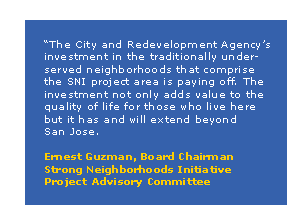 attractive neighborhoods with strong, independent, and capable organizations. attractive neighborhoods with strong, independent, and capable organizations.
The core strategy is to provide meaningful and visible change in each neighborhood through five initiatives--affordable housing, cleaner neighborhoods, safer and more attractive residential streets, vital business districts, and new parks and community centers. These initiatives emerged from the planning processes whereby neighborhood improvement plans for each neighborhood established key priorities throughout the project area.
Within the , 19 Neighborhood Action Coalitions (NACs), consisting of neighborhood stakeholders, developed specific improvement plans in 2002 that clearly articulated neighborhood priorities. These NACs continue working closely with and Redevelopment Agency staff to implement the neighborhoods' top priority projects.
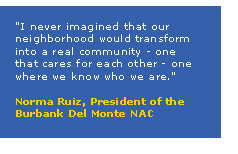 More than 120 priority projects have been completed in areas to date. is on an aggressive schedule to continue implementing priority projects identified by residents within their communities. The Redevelopment Agency has budgeted $12 million in Fiscal Year to further support this effort and continues to serve as a model for community engagement. More than 120 priority projects have been completed in areas to date. is on an aggressive schedule to continue implementing priority projects identified by residents within their communities. The Redevelopment Agency has budgeted $12 million in Fiscal Year to further support this effort and continues to serve as a model for community engagement.
Redevelopment is about Results
The San Jose Redevelopment Agency, in collaboration with many of its partners, has helped to preserve San Jose’s diverse character and capitalized on San Jose’s entrepreneurial spirit and unique mixture of business, culture and community. It has funded programs and projects to advance San Jose’s future generations and industries, while rejuvenating San Jose’s historic neighborhoods and embracing emerging communities. The Redevelopment Agency's investments have increased property values in projects areas 15 fold. It has evolved and adapted to the shifting environment to meet the needs of the people of San Jose. The Agency’s investments have catapulted San Jose to be the world's leading center for innovation and technology enabling the to continually attract local and national developers and retailers to invest in the area.

To subscribe/unsubscribe to this enewsletter, contact the San Jose Redevelopment Agency public information office at or email To ensure that you continue receiving our emails, please addto your address book. San Jose Redevelopment Agency
200 E. Santa Clara Street 14th Floor San Jose, California 95113
Phone: Fax: www.sjredevelopment.org |
About Redevelopment:
The San Jose Redevelopment Agency was created in 1956 by City Council resolution
• Tax increment financing approved by California voters
in 1952
• The Agency is a separate entity from the
• The Agency has funded more than 10,000 affordable homes
Revitalizing Downtown:
• In the early 1980s, the Agency adopted the Downtown Revitalization Strategy which served as the blueprint to rebuild downtown
• Today, the Strategy 2000 guides downtown development
• The Agency has invested more than $1.7 billion in revitalizing downtown San Jose
Fostering Innovation: Since 1977, the Agency has invested more than $430 million in infrastructure to make San Jose’s Industrial Project Areas a magnet for the world’s leading technology companies
Redevelopment Areas are home to 2,200 companies with more than 77,000 employees
is the world's #1 community for innovators
The has the highest concentration of tech companies in the world
Focus on Neighborhoods:
• The Neighborhood Business District (NBD) Program began in the mid-1980s
• The Agency has invested more than $54 million dollars in areas
• More than 120 priority projects have been completed in areas

SJRA Meetings &
Events Calendar
|

